
When to Replace Your Reptile's UVB Bulb (and How Long to Leave It On)
TL;DR
UVB bulbs stop producing useful UVB long before they stop glowing. Replace them on a schedule, not when they burn out.
- Mercury vapor bulbs: replace every 6 to 12 months.
- Linear tubes (T5 HO and T8): replace every 6 to 12 months. T5 HO tubes usually last toward the long end, and T8 tubes toward the short end.
- Compact fluorescent UVB bulbs: replace about every 6 months.
- You can't see UVB. A bulb that looks bright may be producing almost none. The only way to know is to test it.
- We test bulbs for free. Bring yours to The Tye-Dyed Iguana and we'll check it with our UVB radiometer.
- Leave UVB on about 12 hours a day. Run it on a timer alongside the basking light, and turn it off at night.
If your reptile's UVB bulb still lights up, it's easy to assume it's still working. Unfortunately, that's one of the most common and most harmful mistakes in reptile keeping. The visible light and the UVB come from the same bulb, but they don't fade at the same rate. The UVB drops off quietly while the bulb keeps glowing, and your reptile pays the price.
This guide covers how long each type of UVB bulb really lasts, how to tell whether yours is still good, how many hours a day to run it, and how to pick the right replacement.
Why UVB Bulbs Need Replacing Before They Burn Out
UVB bulbs make ultraviolet light using special materials inside the glass. Those materials wear down with use, so the bulb's UVB output falls steadily from the day you install it. The visible light lasts much longer, which is why a bulb can look perfectly normal while giving your reptile little or no UVB.
That matters because reptiles use UVB to make vitamin D3 in their skin. Without D3, they can't absorb the calcium in their food, no matter how much calcium powder you use. Over time that leads to metabolic bone disease, one of the most common and serious problems in pet reptiles.
How Often to Replace UVB Bulbs, by Type
| Bulb type | Replace every | Examples |
|---|---|---|
| Mercury vapor | 6 to 12 months | ReptiRadiant, Zoo Med PowerSun, Exo Terra Solar Glo |
| Linear tube (T5 HO and T8) | 6 to 12 months | Zoo Med ReptiSun T5 HO, Arcadia T5 HO |
| Compact fluorescent | About 6 months | ReptiBrite, Zoo Med ReptiSun compact |
Mercury Vapor Bulbs
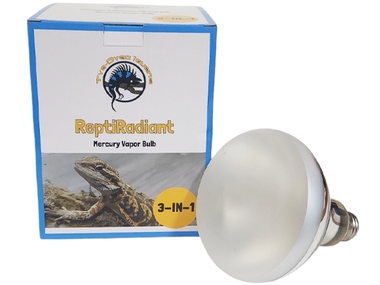
Mercury vapor bulbs produce UVB, UVA, visible light and heat all in one, which makes them popular for large enclosures and high-UVB species like bearded dragons. They are our best-selling type of UVB bulb. Plan to replace them every 6 to 12 months. Running them for long days and turning them on and off often both shorten their UVB life, so testing at the 6-month mark is a good habit.
Linear Tubes (T5 HO and T8)
Linear fluorescent tubes spread UVB across a wide area, which lets your reptile move in and out of it as needed. They also fall in the 6 to 12 month range. T5 high output (T5 HO) tubes are stronger and usually hold their output toward the 12-month end. Older T8 tubes are weaker and fade sooner, closer to 6 months.
Compact Fluorescent Bulbs
Compact UVB bulbs screw into a standard dome fixture and work well for smaller enclosures and low-UVB species. They wear out the fastest, so replace them about every 6 months. A compact bulb may keep glowing for years, but its UVB won't last anywhere near that long.
Newer LED UVB fixtures are rated by their manufacturers to last much longer. They are newer technology, so have them tested regularly like any other UVB source.
How to Tell If a UVB Bulb Is Still Good
You can't tell by looking at it. Brightness has nothing to do with UVB output. Here are the ways that actually work:
- Bring it in for a free test. We test UVB bulbs with a UVB radiometer at our store in Fairview Heights, at no charge. It takes a minute, and it tells you whether the bulb is still in the safe range or has dropped off. Testing is also part of our UVB policy: when you buy a diurnal reptile from us, we check that it is going home to a working UVB bulb.
- Use a UV meter. A handheld UV index meter, such as the Solarmeter 6.5, measures the UVB your reptile actually gets at its basking spot.
- Track the date. Write the install date on the base of the bulb with a marker, or set a phone reminder for 6 months out. Replace on schedule if you can't test.
Don't wait for your reptile to show symptoms. Signs of a UVB problem include lethargy, a poor appetite, trouble climbing, twitching and a soft or swollen jaw. By the time those appear, metabolic bone disease is already underway. A schedule and a test catch the problem first.
How Long Should a UVB Light Be On Each Day?
For most reptiles, leave the UVB light on for about 12 hours a day and off for 12 hours at night. That matches the natural day-night cycle reptiles depend on for sleep, feeding and hormone balance.
- Use a timer. A lighting timer keeps the schedule consistent, even when you're away.
- Run it with the basking light. Reptiles bask to warm up, and they get their UVB at the same time, so the two should be on together.
- Turn it off at night. Reptiles need real darkness to rest. Nighttime UVB serves no purpose and wears out the bulb faster.
- Adjust for the seasons if needed. Some keepers shorten the day to around 10 hours in winter and lengthen it to around 14 in summer, especially for species that brumate. Ask us if you're unsure what your species needs.
Choosing the Right Replacement
Replace a bulb with the same type and strength unless your setup has changed. If you're not sure which bulb your species needs, our guide to reptile UV light requirements by species breaks it down. For a deeper dive into bulb types, mounting distance and fixtures, see the Ultimate Reptile Lighting Guide.
A few things to keep in mind:
- Glass and plastic block UVB. The bulb must shine directly into the enclosure, never through a glass or plastic lid.
- Mesh screens reduce UVB. A standard screen top blocks a significant portion, so the bulb may need to be closer or stronger.
- Distance matters. UVB weakens quickly with distance. Follow the mounting distance on the packaging for your bulb.
- Use the right fixture. Mercury vapor bulbs need a ceramic socket rated for their wattage. See wire vs dome fixtures for help choosing.
You can find mercury vapor bulbs, T5 HO tubes, compact bulbs and fixtures in our UVB bulbs and light fixtures sections, including our own ReptiRadiant and ReptiBrite bulbs.
Common UVB Mistakes
- Waiting for the bulb to burn out. It will keep glowing long after its UVB is gone.
- Not tracking the install date. Without a date, there's no way to know when replacement is due.
- Putting a mercury vapor bulb on a dimming thermostat. These bulbs need full power to work properly. Control heat by adjusting the bulb's wattage or height instead.
- Shining UVB through glass or plastic. Almost none gets through.
- Leaving UVB on around the clock. Reptiles need a dark night, and the bulb wears out faster.
- Using a weak bulb for a high-UVB species. Bearded dragons and other desert species need stronger UVB than a compact bulb usually provides.
Bringing It All Together
A UVB bulb can look fine and still be failing your reptile. Replace mercury vapor bulbs and linear tubes every 6 to 12 months, and compact bulbs about every 6 months. Write the install date on the base, run the light about 12 hours a day on a timer, and keep it off at night.
When you're not sure, don't guess. Bring your bulb to The Tye-Dyed Iguana in Fairview Heights and we'll test it for free, so you know exactly where it stands.
Frequently Asked Questions
How often should I replace my reptile's UVB bulb?
It depends on the bulb type. Replace mercury vapor bulbs and linear tubes (T5 HO and T8) every 6 to 12 months, and compact fluorescent UVB bulbs about every 6 months, even if they still light up.
How long do UVB bulbs last?
The visible light can last for years, but the useful UVB output does not. Most UVB bulbs stay effective for 6 to 12 months, and compact bulbs for about 6 months.
How long does a UVB light need to be on each day?
About 12 hours a day for most reptiles, on a timer, together with the basking light. Turn it off at night so your reptile gets a full dark period.
How do I know if my UVB bulb is still working?
You can't tell by looking at it. Test it with a UV meter, or bring it to The Tye-Dyed Iguana for a free test with our UVB radiometer. If you can't test it, replace it on schedule.
How long do mercury vapor bulbs last?
Mercury vapor bulbs usually provide useful UVB for 6 to 12 months. Testing at the 6-month mark tells you whether yours can stay in longer.
Should a UVB light be on at night?
No. Reptiles need darkness at night to rest, and running UVB around the clock wears out the bulb faster without any benefit.
Does UVB go through glass?
No. Glass and most plastics block nearly all UVB, so the bulb must shine directly into the enclosure. Mesh screen tops also block part of it.
Cited Bibliography
- The Tye-Dyed Iguana. "The Ultimate Reptile Lighting Guide: UVB, Basking, and How to Get It Right." thetyedyediguana.com
- The Tye-Dyed Iguana. "Reptile UV Light Requirements: Which Species Need What." thetyedyediguana.com
- The Tye-Dyed Iguana. "Metabolic Bone Disease in Reptiles: Signs, Causes, Cure." thetyedyediguana.com
- The Tye-Dyed Iguana. "UVB Policy." thetyedyediguana.com